What Small Business Owners Get Wrong About SEO (with Mariah Magazine)

Search optimisation for a small business is research before it is technique: keyword data validates demand before you build, purchase-intent terms are the overlooked slice that both ranks and converts, and real competition is what the ranking pages actually do. Links are earned through PR and relationships, a cold visitor needs the human and the proof up front, and a generated draft ranks without converting — the voice buyers hire is one a machine cannot fake.
Leave a Comment
Abstract
An hour with a consultant who learned the trade on the job and now teaches it to owners in plain language. The through-line is that search is less competitive than the people avoiding it believe, and that most of what stops a small business ranking is not difficulty but a missing foundation — the term absent from the title, the page that answers questions nobody is buying from, the strategy written after the site was built.
- Keyword research doubles as demand validation: confirm people are typing for the thing before anything gets built.
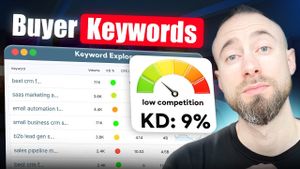
- Purchase-intent terms are lower in volume, easier to reach and convert far better than informational ones.
- Every term maps to a page that makes money, because appearing is not the objective.
- Public relations does the link building, and answering one journalist query a day compounds into a permanent lift.
- Cold search traffic needs the trust factors a warm referral never asks for.
- A model is for repurposing material that already exists, never for writing the page.
Everything below follows the conversation in order, from the self-taught entry through keyword research, competitive reading and the site itself, into client buy-in, the in-person and online methods for finding work, and out through what a model should and should not touch. For anyone building a personal brand the useful part is the voice argument at the end: the brand's voice is one person's voice, and that is the part nothing can fake.
Chapter summaries
00:10 - The path in was self-taught, on the job, with nothing behind it
A self-taught path into the trade: quit a design course and a full-time job in one month, took a paid internship at a tiny agency and learned on the job.
"My background is I started this business when I was 22. I basically I quit college."
— 00:10
Nothing about the entry was credentialled. A design course and a full-time job both ended in the same month, replaced by a paid internship at a tiny agency and learning on the job — which is worth noting before any of the advice, because the advice is shaped by never having been taught the jargon first.
02:07 - Keyword research doubles as demand validation before anything is built
Keyword research can be used as demand validation — proof people want a thing — before any page is built.
"I had a client and they're an e-commerce client"
— 02:07
The order is the insight. Research the demand, confirm people are typing for the thing, and only then build. Validation before construction turns a keyword tool into a market-research instrument, and in this case it produced a large wholesale order before anything went on the site at all.
03:59 - Short buyer-intent pages rank and convert better than question-answering articles
An alternative to question-answering content: put up dozens of short pages that sell to searchers already looking to buy; they rank and convert far better with less work.
"This method of marketing is so effective, I had to make sure it wasn't against Google's rules before I kept using it."
— 03:59
They rank more easily and convert far better, and they take less work than the explainer they replace. The trade is volume of pages against depth of any one, aimed squarely at people already looking to buy.
05:20 - Search reaches people who want the thing and have never heard of the brand
The mind-blowing property of search: you can show up, without ads, for people who want what you sell right now and do not yet know your brand exists.
"that was such a huge confident boost,"
— 05:20
No advertising budget is involved. Someone who wants exactly what you sell, right now, and has never heard of you, arrives anyway — which is the property that makes the channel worth learning rather than outsourcing.
07:57 - The heading and the core content stay evergreen while the photos change
A site's H1 and core content must be evergreen, not re-gutted every season; you can swap photos, not the heading and structure.
"We can't do that. We can we can swap out"
— 07:57
Seasonal rebuilds destroy the thing that was ranking. Photographs, offers and framing can change; the heading and the structure underneath cannot, because those are what the engine has learned the page is about.
09:19 - Many businesses already hold the authority to rank and do not know it
Many businesses already hold enough domain authority to rank for lucrative purchase-intent keywords and do not know it, because they do not know basics like putting the keyword in the page title or URL slug.
"I think it's also really cool that you're just trying to give the foundational skills to these business owners"
— 09:19
Authority that was earned incidentally sits unused because nobody put the term in the title or the slug. The gap between what a site could rank for and what it does rank for is frequently a matter of basics, not competition.
09:58 - The gap in the market was plain language between the experts and the vague agencies
The market gap she entered: advanced SEOs talk only to other advanced SEOs, and agencies stay deliberately vague to keep retainers, so there was no plain-language middle option.
"A lot of my clients think that and this is this is kind of why I got into SEO specifically"
— 09:58
Advanced practitioners talk to other advanced practitioners, and agencies stay deliberately vague to protect retainers. Between the two there was nothing in plain language, which is a market description as much as a complaint.
10:50 - Search is less competitive than the people avoiding it believe
SEO is not as competitive as people think; they believe they need a technology degree, and that belief is the barrier.
"SEO is not as competitive as you think that it is because everybody's seeing all of this like super advanced"
— 10:50
The barrier is a belief rather than a difficulty. People assume a technical degree is required, see the advanced material and conclude it is not for them — and the field is less competitive precisely because so many exclude themselves.
11:38 - "Nobody searches for what I do" means the seed term is too far down the journey
"Nobody searches for what I do" almost always means the owner is too far down the buyer's journey, typing whole sentences; shorten the seed term and let the tool surface variations.
"do you ever hear from business owners who say like, 'Nobody is searching for what I do.'"
— 11:38
It almost always means the seed term is too far down the buyer's journey — a whole sentence rather than a phrase. Shortening the term and letting the tool surface variations turns an apparent absence of demand into a list of it.
12:28 - Owners guess at keywords from industry experience rather than from data
Owners guess "keywords" from industry experience with no data; that is not how customers actually type into a search engine.
"often times business owners are literally putting in what they think are keywords based on just like working in"
— 12:28
Industry experience produces the vocabulary of the seller, not the buyer. What the owner calls the thing and what a customer types are different strings, and only one of them is in the data. The language belongs to the audience.
12:52 - The keyword is not the positioning
Your SEO keyword is not your messaging and positioning; the keyword is the broad literal term people search, and positioning lives in the H1 and content, pulling in secondary keywords.
"I try to explain to people that your SEO keywords are not your messaging and positioning."
— 12:52
They connect, but they are not the same object. The keyword is the broad literal term people search; the positioning lives in the heading and the content, which pulls in the secondary terms. Collapsing the two produces pages that rank for nothing and say nothing.
13:38 - Purchase-intent terms are less competitive, lower volume and convert far better
Purchase-intent (transactional/commercial) keywords are easier to rank for, less competitive, more specific and lower volume, yet convert far better; informational terms are largely avoided.
"what's your method for doing keyword research"
— 13:38
Transactional and commercial terms are more specific, lower in volume and easier to reach — and they convert. Informational terms are largely avoided, which is the opposite of the advice most content plans are built on.
14:46 - Keywords get mapped to the pages that make money
Keywords should be mapped to money pages — product, service and sales pages — because the point of SEO for a business is to make money, not to appear for its own sake.
"my approach is really trying to get people to do that exact thing."
— 14:46
Every term points at a product page, a service page or a sales page, because the purpose is revenue rather than visibility. Appearing is not the objective, and a keyword with nowhere profitable to land is a keyword to drop.
15:33 - Strategy comes first and the site is rebuilt to match, never the reverse
The "SEO sandwich": strategy and keywords first, find the market gaps and priorities, then rebuild the site to match — never force approved keywords onto pages whose intent does not fit.
"I call my approach like the SEO sandwich. So, it's like we do SEO strategy first. We do the keywords."
— 15:33
Strategy and keywords first, then the gaps and the priorities, then the site is rebuilt to match. What is never done is forcing an approved keyword onto a page whose intent does not fit it, which is the failure mode the order is designed to prevent.
17:24 - Keyword research runs through competitors and down the rabbit hole
Keyword research starts from competitor analysis and follows the rabbit hole — search a promising term, scan the results page for adjacent words, feed them back into the tool, and pick a new competitor at the wall.
"most of the time when I'm doing keyword research a lot of the time I'm starting"
— 17:24
The method is iterative rather than clever: start from a competitor, search a promising term, read the results page for adjacent words, feed those back into the tool, repeat until it stops producing, then pick a new competitor and start again.
17:51 - The competitors are whoever ranks for the words in question
In SEO your competitors are the sites ranking for the words you want, not your brand competitors.
"no competitors in terms of like the words that you want to show up for."
— 17:51
It is a definition worth correcting early. The competitors that matter are whoever currently ranks for the words in question, which is often not the businesses the owner thinks of as rivals at all.
19:28 - Difficulty is read against the client's authority, not in the abstract
Easy versus hard is set by keyword difficulty relative to the client's domain authority, but a great-fit keyword is not dropped just because difficulty is high.
"it depends on the client, right? Like if I have a client and their domain authority is a three,"
— 19:28
Difficulty is meaningless in isolation. It is read against the client's own authority, and a term that fits the business perfectly is not abandoned because the number is high — it is scheduled rather than dropped.
20:42 - Topical authority can beat raw domain authority
Topical authority can beat raw domain authority: a tightly niched site can outrank higher-authority competitors.
"we can get over that domain authority hurdle if we have topic authority on the site"
— 20:42
A tightly niched site can outrank higher-authority competitors, which is the practical escape from the authority trap. Owners misread the tool's number as a rule because nobody has told them what actually makes a term competitive.
21:55 - What makes a keyword competitive is how many businesses truly target it
What actually makes a keyword competitive is how many businesses are truly targeting it, which the results page answers by whether the term sits in their titles, slugs, headings and first sentences.
"What I always say is just like why don't you look at like see how many other businesses are actually trying to rank for"
— 21:55
The real measure is how many businesses are genuinely targeting the term — whether it appears in their titles, slugs, headings and opening sentences. Reading the results page backwards answers a question the difficulty score only gestures at.
22:56 - The term gets searched first, to see what intent it returns
A keyword must match how the search engine reads it, so the term gets searched first to see the intent it returns before it is targeted.
"I had a client, she was a public speaking coach,"
— 22:56
The engine's interpretation is the one that counts. Searching the term first shows what intent it returns, and a mismatch there invalidates the target no matter how well it reads on a spreadsheet.
24:13 - Link building happens rarely, and public relations does the work
Link building is done rarely; the favoured method is PR, and the best links come from doing marketing good enough to earn referral traffic.
"Building links? Not often."
— 24:13
The preferred method is public relations, and the best links arrive as a by-product of marketing good enough to send referral traffic. Links pursued directly are the rarest activity in the whole practice.
25:38 - Public relations for a small owner means answering journalist queries
PR is made approachable for small owners as getting quoted in the media through journalist-query platforms — brand-authority backlinks plus referral traffic, no retainer.
"So it's like getting quoted in the media."
— 25:37
It becomes concrete and affordable: answer journalist queries, get quoted, collect the authority link and the referral traffic without a retainer. That reframing is what makes public relations available to a business that could never hire for it.
26:35 - One answer a day compounds into a permanent ranking spike
A daily, compounding habit works: answering one journalist query a day for a couple of weeks produced a single do-follow link on a major health site and a permanent ranking spike.
"every day for the next 30 days I'm going to be building links for this."
— 26:35
One answer a day for a couple of weeks produced a single strong link on a major site and a permanent lift. The habit is small enough to keep and the payoff is not proportional to the effort, which is the definition of a compounding move.
27:16 - One journalist relationship cascades across many publications
Journalists write for multiple publications, so one strong answer can cascade into further features on other outlets.
"these journalists usually write for more than one publication."
— 27:16
Journalists write for several publications, so one good answer can cascade. Treating each mention as a one-shot wastes that — being gracious, offering connections and becoming a go-to source turns one relationship into stories across many domains.
30:39 - Generative visibility cannot exist without the foundation underneath it
The "AI is the new SEO" framing is overblown: generative-answer visibility cannot exist without a solid SEO foundation, and those who invested in modern SEO get quoted and recommended by AI more easily.
"There's like a pretty big overlap I would say."
— 30:39
The framing that treats generative visibility as a replacement is overblown: it cannot exist without the foundation underneath it, and the people who invested in that foundation are the ones being quoted. The new layer sits on the old one.
32:45 - A good website is the training manual for the business
A "good solid website" is one set up for a positive user experience, built on knowing the audience, and treated as the training manual for the business.
"a website that's set up for a positive user experience."
— 32:45
It is set up for a positive experience, built on actually knowing the audience, and treated as the training manual for the business — a description that puts the site's job before any of its features.
33:04 - The about page matters more as generated sites proliferate
An about page matters more as AI-built sites proliferate — humans buy from humans, and the search engine's own guidelines look for about and contact pages to verify a real business.
"we need a homepage. We need an about page. A lot of people like to skip about pages"
— 33:04
Humans buy from humans, and as generated sites proliferate the page that proves a person is behind the business does more work, not less. The engine's own guidelines look for about and contact pages to verify a real business, so the page earns its place twice.
34:24 - Every service gets its own page, and the page gets detailed
Give each service its own page rather than one combined page, and make service pages detailed — process, FAQs, timeline, what is and isn't included — because buyer types differ and fact-finders need it all.
"the other thing is having separate service pages for your services."
— 34:22
Buyer types differ, and the fact-finders need everything: process, questions, timeline, what is included and what is not. One combined page serves none of them well, and a detailed page per service serves each of them properly.
35:00 - Cold traffic needs the trust factors a warm referral never asks for
Traffic from SEO and AI arrives cold, unlike referral or warm leads, so the site must carry trust factors — testimonials, reviews, credentials, relevant past awards.
"a lot of people coming to your website when you are focusing on SEO are cold leads."
— 35:00
Referral and warm leads arrive already convinced; search traffic does not. Testimonials, reviews, credentials and relevant awards are doing the work a personal introduction would otherwise have done, and a fast-loading page is part of the same job.
36:58 - Platform choice matters more for a non-technical owner than for anyone else
CMS guidance for non-technical owners: a mature developer platform is the favourite, but for DIY owners two hosted builders are recommended (one recently improved its SEO backend after hiring a specialist); avoid course/membership platforms as website builders.
"my favorite is just because I was born into this world. It's WordPress."
— 36:58
The advice splits by who is building. A mature developer platform is the preference, two hosted builders are the recommendation for owners doing it themselves, and course or membership platforms are not website builders no matter what they claim.
38:37 - The biggest needle-mover is the full foundational strategy rather than one tweak
The biggest needle-mover is keyword research plus mapping keywords to the pages that make sense and telling the client what to add — the full foundational strategy, not one isolated tweak.
"the biggest needle mover honestly is like keyword research and being able to like map the keywords to pages"
— 38:37
Not one isolated tweak but the whole foundation: research the terms, map them to the pages that make sense, and tell the client what is missing. Everything else is an adjustment to a structure that has to exist first.
39:24 - The keyword goes in the heading, the title and the description
To target a keyword on a page, place it in the H1 heading, the SEO title and the meta description — and the H1 need not be the largest text on the page; there is real flexibility.
"I would say not anymore. I think because of my confidence on it"
— 39:24
The heading, the title and the meta description carry it, and the heading does not have to be the largest text on the page. That flexibility removes the design objection that stops a lot of owners before they start.
40:28 - Client buy-in comes from explaining the why once
Client buy-in comes from connecting the why to their business and showing an example or the data — a short call that explains earns buy-in for every later decision; framed as collaborative.
"there's such a mix of of people who listen to this show."
— 40:28
A short call connecting the reasoning to their business — with an example or the data — buys agreement for every later decision. Framing it as collaborative is not a technique so much as an accurate description of what the call is.
42:38 - Agencies fail by ignoring intent and forcing keywords onto the wrong pages
Many agencies fail because they ignore intent — throwing keywords onto pages where they make no sense — and honesty about the strategy is what actually earns trust.
"the issue that I have found with SEO agencies is that they don't pay enough attention to intent."
— 42:37
Keywords get thrown onto pages where they make no sense, and the client cannot tell until it fails. Honesty about the strategy is what earns the trust the agency was supposed to be selling.
43:54 - Arriving early beats working the room
An in-person client-getting method: stop working the room handing out cards; arrive early when people are anxious to talk, then spend the whole event with one person.
"How did I get my first client was word of mouth."
— 43:54
Working the room hands out cards to people who are busy. Arriving early catches people while they are still anxious to talk, and the whole event is then spent with one of them rather than distributed across forty.
45:43 - Changing venue across an evening makes one relationship feel much closer
The "venue change" technique: moving through several places with one person in an evening makes the relationship feel far closer than the time spent.
"dating coaches abuse this technique. It's called the venue"
— 45:43
Moving between several places across an evening compresses months of acquaintance into hours. The relationship feels much closer than the time actually spent, which is a strange and reliable property of changing the setting.
46:29 - Curiosity comes first and the pitch waits until it is asked for
Lead with curiosity: ask about the other person and don't mention what you do until asked; eventually they volunteer a referral unprompted.
"when I would start meeting people, I wouldn't even talk about myself or who I was or what I did until they"
— 46:29
Ask about the other person and do not mention your own work until asked. The referral arrives unprompted, later, because curiosity is the thing people remember being on the receiving end of.
47:22 - A service swap earns third-party proof that outperforms any self-claim
The online equivalent built a whole business remotely through coffee chats and service swaps, trading a search plan for a public-relations plan so that each party earned the other a feature.
"when people are interested in you. I would say I did something similar but in the online space."
— 47:21
Coffee chats and service swaps — a search plan traded for a public-relations plan, each party earning the other a feature. Third-party proof converts better than any self-description.
48:36 - Referral partners belong in adjacent industries rather than competing ones
Cultivate referral partners in adjacent, not competing, industries — PR people, website and brand designers — because they meet the client before you and remember you at launch and redesign.
"who I would connect with mainly, PR people, website designers, and graphic designers, like brand designers."
— 48:36
Adjacent professionals share the same client at a different moment, so the referrals flow both ways rather than one. Designers refer at launch and earn repeat work updating the site to the search plan.
49:52 - One community, entered properly, beats a presence in many
To find a community remotely, join a relevant one and go hard — become the person who answers questions — rather than spreading across many.
"It was Facebook groups. When Facebook groups were popping, there was very specific Facebook groups for women business owners,"
— 49:52
Joining one relevant community and going hard — becoming the person who answers the questions — beats a thin presence across many. The concentration is the entire mechanism, and it does not work at half strength.
52:49 - Paying to be in the room selects for people already willing to spend
Counterintuitively, pay to be in a specific room: members of a paid community are proven willing to spend, and the host with an outside audience learns about you.
"one of the best things that you can do, and I know that it sounds counterintuitive at first, is pay to"
— 52:49
It reads as counterintuitive and is not. People inside a paid community have already proven they will spend, and the host with an outside audience learns who you are. The fee is a filter working in your favour.
54:44 - The community's questions become the content
The community's questions become your content: answer them publicly, and long-form video in particular shares expertise, brings people in consistently, and is favoured by AI.
"So I'm a chatty person. YouTube just made sense for me."
— 54:44
The questions people ask become the material, answered publicly. Long-form video in particular carries expertise, brings people in consistently and is favoured by the answer engines — and it only works because the questions were real.
56:42 - A page can rank for years off a three-day build
A high-intent page can rank number one for years and bring customers on autopilot for a roughly three-day build — but letting AI write it from scratch anchors you into its way of thinking.
"if you let AI write especially could be like a high intent page"
— 56:42
A high-intent page can rank first for years and bring customers with no further work, off roughly three days of building. That ratio is the strongest argument in the episode for doing the page properly by hand.
57:43 - Over-relying on a model anchors the work into phrasing nobody would choose
Over-relying on AI to structure your own work backfires: it anchors into phrasing you would never use, and the real cost is your energy, willpower and even sleep, not just time.
"This literally happened to me when I was creating my workshop slides for a workshop that I hosted yesterday."
— 57:43
The output anchors you into phrasing you would never have chosen, and the real cost is not time but energy, willpower and sleep. The damage is to the thinking rather than to the draft.
58:52 - The defensible use is repurposing material that already exists
The defensible AI use is repurposing your own already-made material — turning a video transcript into a blog post, rewriting specific sentences — never generating whole pages.
"The main thing that I use AI for is repurposing my YouTube videos into blog posts."
— 58:52
Turning a video transcript into a post, rewriting specific sentences, reshaping something that already exists — that is the line. Generating whole pages is on the other side of it, and the distinction is about provenance rather than quality.
59:25 - Business owners recognise generated content and want the person instead
Business-owner audiences recognise AI content and want the human — the soul, the perspective; once a reader spots AI they cannot unsee it and will not buy or subscribe.
"if you're marketing to other business owners, they know what AI content sounds like."
— 59:25
Business-owner audiences recognise it immediately and want the person: the soul, the perspective, the thing that could only have come from one operator. Once a reader spots the pattern they cannot unsee it, and they will not buy.
1:00:27 - Generated content ranks on easy terms and converts badly
AI content will rank, especially for low-competition terms, but converts poorly; on higher-competition terms the engine leans on user signals, so a visitor pogo-sticking back to results hurts you.
"it will rank, but it just won't convert very well."
— 1:00:27
It ranks, particularly on low-competition terms, and then converts badly. On competitive terms the engine leans harder on user signals, so a visitor bouncing back to the results actively costs you the position.
1:01:12 - Most of what gets quoted and recommended is human-written
A cited figure: reportedly 82% of the content being quoted and recommended by AI is human-written — because AI favours unique perspectives, while everyone using AI retrains it on the same mediocre output.
"There was a study that I actually just had to pull for my workshop yesterday"
— 1:01:12
A reported majority — something like four in five — of what gets quoted and recommended is human-written, because unique perspective is what gets selected. Meanwhile everyone using the same tools is retraining them on the same mediocre middle. Distinctiveness is the whole asset.
1:02:35 - The non-core copy is fair game and the product itself is not
AI is fine for the copy that is not the product — episode descriptions and titles, a newsletter reworked for the blog, individual sentences — but never for the whole thing, because the description is not the podcast.
"Look, I use AI for writing all the time."
— 1:02:35
Episode descriptions, titles, a newsletter reworked for the blog, individual sentences — none of those are the product. The description is not the podcast, and the line holds as long as the thing being generated is not the thing being sold.
1:04:35 - A personal brand's voice is the person's voice, and it cannot be faked
For a personal brand the voice of the brand is the voice of the person, which AI cannot fake — it lacks the experience — and people hire precisely because they can feel that person in the writing.
"maybe it's because I'm more of a personal brand, you know what I mean?"
— 1:04:35
For a personal brand the brand's voice is one person's voice, and a model has no experience to draw it from. People hire because they can feel that person in the writing, which is precisely the thing that cannot be synthesised.
1:05:39 - The practice that should die is obsessing over alt text
The best practice that should die: obsessing over image alt text while not understanding how SEO works — owners treat it as the lever and think SEO is a technical checklist to tick off.
"Focusing on image alt text when you don't understand how SEO works."
— 1:05:39
Owners treat alt text as the lever because it is the only lever they have been shown, which turns the whole practice into a checklist to tick rather than a strategy to run. The same treatment applies to creative businesses: foundational work on the pages that make money, not a different discipline.
Personal Branding Lessons
An episode aimed at owners rather than practitioners. The moves below are all foundation work, which is why they are the ones that get skipped.
Use keyword research to validate demand before building anything
Research the demand, confirm people are typing for the thing, and only then build the page. That order turns a keyword tool into a market-research instrument, and in this case it produced a large wholesale order before anything went on the website at all. The deeper effect is a confidence shift: marketing stops feeling like guessing. 02:07
Target purchase-intent terms rather than informational ones
Transactional and commercial terms are more specific, lower in volume and easier to reach — and they convert, which informational terms largely do not. Avoiding the question-answering content most plans are built on is the single biggest reallocation available, and it costs less work rather than more. 13:38
Map every keyword to a page that makes money
Product pages, service pages, sales pages. The purpose is revenue rather than visibility, so a term with nowhere profitable to land is a term to drop. It sounds obvious and it is the step most often skipped, because ranking feels like the goal right up until it produces nothing. 14:46
Search the term before targeting it
The engine's interpretation is the one that decides. Searching the term first shows what intent it actually returns, and a mismatch there invalidates the target no matter how good it looked in the tool. It costs thirty seconds and it prevents building a page against the wrong meaning entirely. 22:56
Answer one journalist query a day
A daily answer for a couple of weeks produced a single strong link on a major site and a permanent ranking lift. The habit is small enough to sustain, and the payoff is not proportional to the effort. Journalists write for several publications, so one good answer can cascade into features elsewhere. 26:35
Arrive early and spend the event with one person
Working the room distributes cards to people who are busy. Arriving early catches people while they are still anxious to talk, and the rest of the evening goes to one of them. Moving between venues across that evening makes the relationship feel far closer than the hours spent would suggest. 43:54
Cultivate referral partners in adjacent industries
Public relations people, website designers, brand designers — they meet the client before you do, and they remember you at the launch and at the redesign. Competing industries do neither. The distinction between adjacent and competing is what makes the network produce work rather than conversation. 48:36
Use the model to repurpose your own material, never to write the page
Turning a video transcript into a post, rewriting specific sentences, reshaping something that already exists — that is the defensible line. Generating whole pages crosses it, and the cost is not just quality: the output anchors you into phrasing you would never have chosen, and the damage is to the thinking. 58:52
Questions
Each answer ends at the moment in the recording where it is given.
Can I use keyword research to know what to sell before I build anything?
Yes — that is treated as its most valuable use. A term with real monthly volume and almost no competition is read as proof that people want something nobody is answering, and a decision can be made on that proof before a page exists. In the story told, a wholesale order landed for a product that had not been made yet, purely because the search data validated the demand first. 02:07
Should I target purchase-intent keywords or informational ones?
Purchase-intent terms are strongly favoured for a business. They are more specific, which makes them less competitive and lower in volume, so fewer businesses chase them — yet the intent behind them is high enough that they convert far better than informational queries. It is described as the rare overlap where a term is both easy to rank for and easy to turn into a sale, which is exactly the slice most owners overlook. 13:38
How do I actually do keyword research from scratch?
The method starts with competitors — whoever ranks for the words you want, not your brand rivals — and runs as a loop: find a promising term, search it, scan the results page for adjacent words, feed those back into the tool, and repeat until it stalls, then pick a new competitor. A single run ends in a long list, bucketed afterwards into pages and supporting posts that fit the business. 17:24
What really makes a keyword too competitive for me to rank?
Not the difficulty score most owners treat as a verdict. What decides it is how many businesses are genuinely targeting the term — whether it appears in their page titles, URL slugs, headings and first sentences — which you read straight off the live results page by working backwards from who ranks. Reading an estimate as a rule, a form of trusting the number over the judgement, is what makes people abandon winnable terms. 21:55
How do I get backlinks without paying for them?
Rarely through deliberate link building; mostly through public relations. The strongest links fall out of marketing good enough to earn referral traffic, and the approachable version is getting quoted through journalist-query platforms. A daily habit is described — one answer a day for a couple of weeks — that produced a single authoritative link and a lasting ranking lift, because an earned mention carries evidence that a bought one never does. 24:13
Does AI search mean SEO is dead?
No — the framing is called overblown. Visibility in generative answers cannot exist without the same solid foundation, and the sites that already invested in modern optimisation get quoted and recommended more easily because the trust, authority and scannable structure are exactly what the AI layer reads. The foundation carries straight over rather than being replaced; the new layer sits on top of the old one. 30:39
What does a small business website actually need to rank and convert?
A site built for a cold stranger, since organic and AI traffic arrives with no prior relationship. That means an about page showing the human, a real contact route rather than a bare form link, separate detailed pages for each service, and visible proof of competence — reviews, credentials, relevant past awards. It is framed as the training manual for the business, moving a visitor page to page and answering their real questions. 32:45
Which website platform should a non-technical owner use?
For an owner who wants to run the site themselves, a hosted site builder is recommended over a powerful developer platform they cannot operate — one such builder is noted as having recently improved its optimisation backend. The firm exclusion is course-and-membership platforms: they lack the features a real website needs and should not host one. Whatever the choice, the site has to load quickly. 36:58
How do I get clients if I can't network in a big city?
Join one relevant community and go hard rather than spreading thin — and pay to be in a specific room if that is what filters for people who actually spend. Become the source who answers questions there, and let those questions become your content. Coffee chats, reciprocal service swaps, and referral partners in adjacent trades — designers, PR people — build a standing referral loop entirely online. 49:52
Sources
What Small Business Owners Get Wrong About SEO (with Mariah Magazine)
The sections above follow the episode's own order. Each timestamp is the point in the recording where the idea is discussed, so the post reads as a map of the conversation rather than a rearrangement of it.
Quotations come from the episode transcript with spoken filler ("okay", "right", "you know", "um", "actually", "kind of", "sort of") and false starts removed. No words are added: square brackets mark anything inserted for sense, and an ellipsis marks any cut. British spellings are restored, and speech-to-text errors were repaired against context only where the intended word is unambiguous. Where a line appears both in a cold-open teaser and in its place in the conversation, the timestamp cites the second — the point at which it is actually said.
Quotes are stamped with the moment they are said rather than with a speaker's name.