SEO Backlinks For Beginners - Episode 134

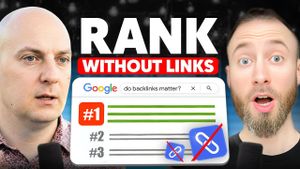
Backlinks are the whole game because ranking needs authority, authority is a measure of a site's trustworthiness, and the only way to earn it is a link from another website — nothing on your own site creates it. But rankings are relative, so you need more authority than your competition, not a fixed amount, and it turns on quality, not quantity: one strong link beats a hundred worthless ones. Earning good links is the hardest part, and that difficulty is the point.
Leave a Comment






Abstract
Fifteen minutes on backlinks for someone who has never built one, from a practitioner who repeats twice that everything he is about to say is fourteen years of agency experience rather than inside knowledge of how the engine works. The argument is a chain rather than a list: ranking requires authority, authority is a measure of a site's trustworthiness, and links from other sites are the only thing that produces it.
- A backlink is a link from one website to a different website, and the distinction from an internal link is the whole basis of what follows.
- Of roughly two hundred things that affect ranking, four are worth attention: avoid a penalty, have content, be relevant, have authority.
- Content is necessary and content quality is not a ranking factor, because there is no way to code an opinion.
- The requirement is not authority but more authority than whoever is ranking now.
- Authority passes in proportion to what the sending site holds, which is why volume at the bottom of the scale adds almost nothing.
- There are four ways to get links, and waiting passively is named as bad advice rather than as a slow option.
Everything below follows the episode in order, from the definition through the four-factor model, into how authority is shared, and out to the four acquisition routes taken one at a time. For anyone building a personal brand the transferable part is the shape of the argument: a short closed list, stated flatly, with the exceptions acknowledged and then deliberately set aside.
Chapter summaries
00:52 - Every claim is framed as agency experience rather than as inside knowledge
Every claim is framed as fourteen years of agency experience and opinion, not as inside knowledge of how the engine actually works.
"Everything I say here is based on my experience and opinion from 14 years."
— 00:52
Nothing here is presented as inside knowledge of how the engine works, and the framing is repeated rather than buried in a disclaimer. That matters for how the rest is read: the claims that follow are strong, and every one of them is an inference from fourteen years of watching sites move rather than a statement about the mechanism.
01:44 - A backlink is a link from one website to a different website
A link moves you from one web page to another; a backlink is a link from one website to a different website; a link to another place on the same site is an internal link, not a backlink.
"On to the episode. So let's talk about backlinks. If you've ever studied."
— 01:42
The definition turns entirely on whether the link crosses from one site to another. Clicking a result, or clicking a link on a page that takes you elsewhere, is the everyday form of it.
03:01 - Authority is a measure of a website's trustworthiness, and ranking requires it
Backlinks matter because ranking requires authority, and authority is a measure of a website's trustworthiness.
"Talk about why backlinks are important. Backlinks are important because there is something that."
— 03:01
Trustworthiness is what the measure is standing in for, and nothing on your own site can vouch for it. That is the chain in full: links are not the goal, authority is, and links are the only thing that produces it. Trust is the thing being measured, and everything else in the episode is downstream of it.
03:41 - Of roughly two hundred factors, only four are worth attention
Of roughly two hundred things that affect ranking, only four are worth paying attention to: avoid a penalty, have content, be relevant, have authority.
"This is a good place to talk about why this is important."
— 03:41
Avoid a penalty, have content, be relevant, have authority. The number is the argument — it says most of what is discussed in the field is real and negligible, which is a harder claim than saying it is false.
04:19 - Content is necessary, and content quality is not a ranking factor
Content is necessary, but content QUALITY is not a ranking factor: the engine can tell what content is about, not how good or helpful it is.
"A penalty. Number two, you need content. The quality of your content is not."
— 04:19
Content is necessary and content quality is not a ranking factor. The engine can tell what a page is about; it cannot judge whether the writing is any good, because there is no way to code an opinion. Relevancy is the same distinction applied to topic rather than to craft: readable, not judgeable.
05:17 - Ranking needs more authority than the competition, not authority in the abstract
You cannot rank without authority — more precisely, without MORE authority than your competition.
"You need backlinks to get authority, because you cannot rank without authority."
— 05:17
The requirement is not authority but more authority than whoever is currently ranking. That reframes the whole problem from a threshold to a contest, and it explains why the same site can rank in one market and not in another without changing at all.
05:58 - Authority is shared through links, and the amount scales with the linking site
Authority is shared through links, and the amount shared scales with the linking site's own authority: a high-authority site passes a lot, a low-authority site passes little.
"About how authority is shared. So most of the websites on the internet have."
— 05:58
Authority is shared through links, and the amount shared scales with the linking site's own authority — so a link from a strong site carries more than a link from a weak one. The consequence is arithmetic rather than moral: ten weak links do not add up to one strong one, because the sharing is proportional to what the sender has.
06:47 - Backlinks are the only source of authority, and on-site work creates none
Backlinks are the only way to get authority; nothing done to your own site creates it, and claims to the contrary are mistaken.
"Clear, there are exceptions to everything I just said, but we're keeping this."
— 06:47
Nothing done to your own site creates it, and claims to the contrary are named as wrong rather than debated. He grants immediately that there are exceptions to everything just said and that the episode is being kept simple, which is the honest version of a strong claim. The vote has to come from somebody else.
07:52 - The aim is quality rather than more, which is where most operators go wrong
The common misconception is that the aim is MORE backlinks, so people go and buy many low-quality ones, when it is about quality rather than quantity.
"It's a common misconception that it is about getting more backlinks."
— 07:52
The value of a link varies enormously, which makes a count the wrong measure to optimise. One strong backlink can reach the top where a hundred worthless ones help not at all.
09:19 - Finding good backlinks is the hardest part of the discipline
Finding good-quality backlinks is the hardest part of SEO; if it feels hard, that is correct.
"This episode. So now you're probably thinking."
— 09:18
High-authority sources willing to link are scarce, and that scarcity is the whole difficulty. Nothing else in the four variables is hard to satisfy by comparison.
10:01 - Waiting to be linked fails, because nobody links to a page they cannot find
The first way — do nothing and let people link to you — is bad advice: if you do not rank and cannot be found, nobody knows you exist to link to you.
"Just to be clear. So first way, do nothing and let people link."
— 10:01
The first route — do nothing and let people link to you — is named as bad advice rather than as a slow option. The reasoning is circular in the way reality often is: if you do not rank you cannot be found, and if you cannot be found nobody links to you. Passive acquisition assumes the outcome it is supposed to produce.
10:45 - Buying links is against most published guidelines and is neither recommended nor condemned here
The second way is to buy links; many engines say this is against their guidelines, and it is offered neither as recommended nor forbidden.
"The second way to get backlinks is to buy them."
— 10:45
The second route is buying, and it is handled without editorialising: many engines say it is against their guidelines, and it is offered neither as a recommendation nor as a condemnation. The restraint is deliberate — the episode is describing what exists rather than ruling on it.
11:27 - Guest posting and outreach trade a written post for a link
The third way is guest posting and link outreach: write a post for another site in exchange for a link, or find an existing article and email the owner to ask for one.
"Understand that. Three, there's something called guest posting and link outreach."
— 11:27
Both trade something the site owner wants — content, or a relevant request — for a placement. Guest posting is a win for both sides, and sometimes the owner charges once they realise why you are writing.
12:18 - Standing up a private network of sites is the fourth route and the most complicated
The fourth way is to build your own: stand up your own websites and use them to link to your site — very complicated and difficult.
"The fourth way to get backlinks is to build your own."
— 12:18
The fourth is to stand up your own sites and link from them, described as very complicated rather than recommended. The list closes by asserting there are not really any other ways, which is the kind of closed claim the four-factor framing keeps producing: a short list, stated flatly, with the exceptions acknowledged and then set aside.
Personal Branding Lessons
The subject is technical and the moves underneath it are not. Each one below is a decision about where to spend attention, made by ruling most of the available options out.
Count the four things that matter and ignore the other hundred and ninety-six
Of roughly two hundred things that affect ranking, four are worth attention: avoid a penalty, have content, be relevant, have authority. The number is the argument. It does not say the rest is false — it says the rest is real and negligible, which is the harder and more useful claim. Anything proposed as important gets sorted against that list before it gets any effort. 03:41
Stop optimising content quality as though the engine could read it
Content is necessary and content quality is not a ranking factor, because there is no way to code an opinion. The engine can tell what a page is about and cannot judge whether the writing is good. Relevancy is the same distinction applied to topic rather than craft: readable, not judgeable. Write well for the reader by all means — just do not expect the machine to notice, and do not spend the budget there expecting a position. 04:19
Measure your authority against the competition rather than in the abstract
The requirement is not authority but more authority than whoever is currently ranking. That turns a threshold into a contest, and it explains why an unchanged site ranks in one market and not in another. It also makes the target knowable: look at what the pages above you actually have, rather than at a number in a tool with no opponent in it. 05:17
Judge a link by the authority of the site sending it
Authority is shared through links, and the amount shared scales with what the linking site itself holds. The consequence is arithmetic rather than moral: ten weak links do not add up to one strong one, because the sharing is proportional. Before chasing a link, ask what the sender has to give — a site with nothing passes nothing, however many of them there are. 05:58
Reject any claim that on-site work creates authority
Backlinks are the only way to get authority, and nothing done to your own site creates it. Claims to the contrary are named as wrong rather than debated, with the honest caveat attached immediately: there are exceptions to everything, and the episode is being kept simple. Carry the strong version as the working rule and keep the caveat in view — a vote has to come from somebody else. 06:47
Buy quality rather than volume when you buy at all
The common misconception is that the aim is more backlinks, and people act on it by acquiring a great many low-quality ones. The aim is quality, for the arithmetic reason above. Buying is handled without editorialising here: many engines say it is against their guidelines, and it is offered neither as a recommendation nor as a condemnation — the episode describes what exists rather than ruling on it. 07:52
Expect link building to be the hardest part of the work
Finding good-quality backlinks is the hardest part of the discipline, and the line is offered as reassurance rather than complaint: if it feels hard, that is correct. Everything else in the field is cheaper, which is precisely why so much attention flows to the parts that are not load-bearing. Difficulty here is a signal you are working on the right thing. 09:19
Never wait passively to be linked to
The first route — do nothing and let people link to you — is named as bad advice rather than as a slow option, and the reasoning is circular in the way reality often is. If you do not rank you cannot be found; if you cannot be found nobody links to you. Passive acquisition assumes the outcome it is supposed to produce, which makes it a plan that only works for people who no longer need it. 10:01
Questions
Each answer ends at the moment in the recording where it is given.
What exactly is a backlink, and how is it different from an internal link?
A link is what carries someone from one web page to another. A backlink is that same link when it crosses from one website to a completely different website — an outside site pointing at yours. The distinction that trips people up is the internal link: a link to another page on your own site. That stays inside your walls and does not count as a backlink, because the whole value comes from the connection arriving from somewhere else. 01:44
Why do I need backlinks at all?
Because ranking requires something called authority, and authority is read as a measure of how trustworthy a site is. The episode is blunt that this quality has exactly one source: it comes only from links arriving from other sites, and nothing you do on your own site produces it. If a search engine needs a trust signal to decide who ranks first, and links are the only thing that generates that signal, then earning them is the whole task, not an optional extra. 03:01
If I just create great content, won't I rank?
No — and this is stated flatly as untrue. You do need content, but its quality is not a ranking factor. A search engine can tell what a piece is about but cannot judge how good or helpful it is, so it cannot reward merit it cannot detect. That gap is exactly why it leans on authority instead, using who has vouched for a site as a proxy for a quality it has no way to measure directly. 04:19
Do I need a certain amount of authority, or just more than my competitors?
More than your competitors, specifically — not a fixed amount. The episode uses a weightlifting contest to make this concrete: you do not win by lifting a set weight, you win by lifting more than everyone else competing. Ranking works the same way, so the target is relative. You are not clearing an abstract bar; you are out-scoring the particular sites chasing the same position, which means knowing who they are matters as much as the number itself. 05:17
Is it better to have more backlinks or better ones?
Better ones, decisively. Chasing quantity is named as a common misconception — it pushes people to buy cheap, worthless links that do nothing. The value of a link varies enormously with the authority of the site behind it, so a raw count is the wrong measure. One genuinely strong link can carry a site to the top, while a hundred worthless ones help not at all. The whole game is quality, not volume. 07:52
Why is getting good backlinks so hard?
Because it is named that way outright — earning good links is called the single hardest part of the discipline, and if it feels difficult you are reading it correctly. The episode is emphatic and goes no further: it is very hard, and you are right to think it is not easy. It offers no reason beyond that, so treat the difficulty itself as the honest cost of standing worth having rather than a problem to solve away. 09:40
What are the actual ways to get backlinks?
There are four, and no real fifth. The first is to wait passively for links to arrive — named only to be rejected. The second is to buy them, presented neutrally with the guidelines flagged. The third is guest posting and outreach: writing a post for another site in exchange for a link, or emailing the owner of an existing article to ask for one. The fourth is building your own linking sites, the hardest and most complicated route. 10:01
Should I buy backlinks?
The episode deliberately takes no side: it is not telling you to buy them and not telling you not to, only that people do. What it does insist on is preparation — learn the difference between good and bad links before spending anything, and assume that most publicly available link services will not actually help you. Many search engines flag buying links as against their guidelines, so it is offered as a real option with real risk, understood first. 10:45
Sources
SEO Backlinks For Beginners - Episode 134
The sections above follow the episode's own order. Each timestamp is the point in the recording where the idea is discussed, so the post reads as a map of the conversation rather than a rearrangement of it.
Quotations come from the episode transcript with spoken filler ("okay", "right", "you know", "um", "actually", "kind of", "sort of") and false starts removed. No words are added: square brackets mark anything inserted for sense, and an ellipsis marks any cut. British spellings are restored, and speech-to-text errors were repaired against context only where the intended word is unambiguous. Where a line appears both in a cold-open teaser and in its place in the conversation, the timestamp cites the second — the point at which it is actually said.
Quotes are stamped with the moment they are said rather than with a speaker's name.